Not a member of Pastebin yet?
Sign Up,
it unlocks many cool features!
- # THE YOU-NIVERSE
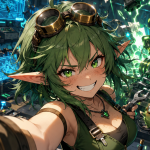
- @Image1 = THE ORIGINAL CHARACTER
- Create one cinematic environmental scene in which the EXACT character shown in @Image1 has suddenly entered a strange alternate world where every local inhabitant is some alternate-world version of that same character.
- The joke and story are simple:
- THE EXACT ORIGINAL CHARACTER is standing in the middle of the scene, beginning to freak out.
- EVERYONE AROUND THEM looks like a different possible version of them.
- Everyone else thinks this is completely normal.
- ---
- # ABSOLUTE ORIGINAL-CHARACTER LOCK — MOST IMPORTANT RULE
- There is ONE ORIGINAL CHARACTER.
- The protagonist near the center must be a direct, faithful recreation of the exact character shown in @Image1.
- DO NOT redesign the protagonist.
- DO NOT gender-swap the protagonist.
- DO NOT create a younger, older, prettier, more human, more feminine, more masculine, or otherwise altered interpretation of the protagonist.
- DO NOT combine the protagonist with traits from any other character.
- DO NOT turn the protagonist into one of the alternate population members.
- The protagonist must preserve exactly the established:
- - sex / gender presentation
- - age
- - species
- - facial structure
- - face shape
- - snout and jaw shape where applicable
- - eye color
- - skin / scale / fur coloration
- - hair
- - hairstyle
- - beard or facial hair
- - horns
- - ears
- - body proportions
- - height and build
- - tail
- - wings or other appendages
- - clothing
- - armor
- - accessories
- - weapons or equipment
- - jewelry
- - markings
- - all other identity-defining features
- Only TWO things may change from @Image1:
- 1. POSE
- 2. FACIAL EXPRESSION
- Everything else belongs to the original character design and must remain intact.
- Think of @Image1 as an actor wearing their exact canonical costume.
- You are merely placing that exact actor into a new scene and asking them to react.
- ---
- # THE ORIGINAL IS FREAKING OUT
- Place the exact original character prominently near the center of the composition.
- They have just realized:
- “Why does EVERYONE here look like some version of ME?!”
- Show them:
- - wide-eyed
- - confused
- - alarmed
- - overwhelmed
- - looking rapidly between different people
- - recoiling slightly
- - holding their hands outward in disbelief
- - visibly trying to process what they are seeing
- Their reaction should be expressive but believable.
- They are NOT posing heroically.
- They are NOT calmly observing the crowd.
- They are having a mild existential crisis.
- The viewer must recognize the exact character from @Image1 FIRST, before noticing the alternate population.
- ---
- # THE ALTERNATE POPULATION — ONLY THEY MAY VARY
- Everyone except the central protagonist belongs to the alternate population.
- These people are NOT exact copies.
- These people ARE allowed and EXPECTED to vary substantially.
- Treat @Image1 as the shared ancestral visual foundation for an entire civilization, NOT as a template that must be copied literally.
- Create approximately 5–7 clearly visible alternate inhabitants.
- Fewer distinctive individuals are strongly preferred over a large crowd of duplicates.
- Prioritize individuality, age diversity, gender diversity, body diversity, clothing diversity, and personality.
- Include visibly different examples such as:
- - a clearly male alternate
- - a clearly female alternate
- - a younger adult
- - an elderly alternate
- - a child or adolescent where appropriate
- - a tall or broad version
- - a smaller or slender version
- These should look like DIFFERENT PEOPLE.
- They should share recognizable visual ancestry with @Image1 while possessing genuinely different:
- - facial structures
- - face shapes
- - jaw shapes
- - noses or snouts
- - ages
- - builds
- - heights
- - hairstyles
- - hair lengths
- - facial hair
- - horn shapes where applicable
- - expressions
- - clothing
- - occupations
- - accessories
- - personalities
- IMPORTANT:
- Variation applies ONLY to the surrounding population.
- Variation NEVER applies to the central original character.
- ---
- # ALTERNATES ARE PEOPLE — NOT CLONES IN DIFFERENT SIZES
- Do NOT simply reproduce the original character repeatedly and change only age, height, or gender.
- Do NOT use the same face on every inhabitant.
- Do NOT use the same hairstyle on every inhabitant.
- Do NOT use the same beard or facial hair on every inhabitant.
- Do NOT give everyone the original character's body build.
- Do NOT make the alternate population look like identical siblings, soldiers, clones, or duplicated character models.
- Each alternate should be individually recognizable as a different person.
- For HUMAN or HUMANLIKE characters especially:
- Do not rely on copying the original character's exact face, shaved head, hairstyle, beard, clothing, armor, or accessories to communicate resemblance.
- Allow substantial natural human variation.
- For example, different alternates may have:
- - different facial proportions
- - different jaw widths
- - different nose shapes
- - different brow structures
- - different hairstyles
- - different hair lengths
- - different facial hair
- - no facial hair
- - different ages
- - different heights
- - different body builds
- - different gender presentation
- They should feel like many alternate possibilities of the same person rather than literal duplicates.
- ---
- # THE ORIGINAL'S CLOTHING IS NOT A CIVILIZATION-WIDE UNIFORM
- VERY IMPORTANT:
- Only the central ORIGINAL CHARACTER must wear the exact canonical clothing, armor, accessories, and equipment from @Image1.
- DO NOT dress the surrounding population in copies of the original character's outfit.
- The alternate population is an ordinary civilization, NOT an army, organization, military unit, cosplay gathering, or uniformed faction devoted to the protagonist.
- Their clothing should vary naturally according to:
- - age
- - gender
- - occupation
- - wealth
- - personality
- - lifestyle
- - social role
- For example, inhabitants may include:
- - a merchant
- - craftsperson
- - laborer
- - traveler
- - scholar
- - civilian
- - shopkeeper
- - parent
- - child
- - elderly resident
- - guard
- - noble
- - street vendor
- Dress them accordingly.
- If @Image1 wears distinctive armor, a cloak, goggles, jewelry, gemstones, weapons, or other signature equipment, DO NOT automatically give those exact items to everyone else.
- Those belong specifically to the original character.
- Alternate inhabitants may contain subtle echoes of the original design language, colors, materials, or motifs, but those echoes must be individually interpreted rather than copied.
- The central original should actually stand out MORE because they are still wearing their exact canonical outfit while everyone else has developed their own lives and wardrobes.
- ---
- # FAMILY RESEMBLANCE — NOT UNIFORMITY
- The surrounding inhabitants should have FAMILY RESEMBLANCE to @Image1 rather than literal duplication.
- Think:
- “Different people who somehow all look like they could have been alternate versions of this character.”
- NOT:
- “The same character copied several times.”
- NOT:
- “An army wearing the character's costume.”
- NOT:
- “Identical twins of different ages.”
- For a human character, resemblance may come from subtle recurring traits such as:
- - related facial geometry
- - similar eye coloration
- - recurring hair-color families
- - recognizable expressions
- - related complexion
- - recurring color motifs
- - subtle echoes of the original aesthetic
- But no single trait needs to appear identically on every person.
- For a fantasy species, resemblance may instead come from:
- - species anatomy
- - scale / fur / skin color families
- - related horn structures
- - ear shapes
- - tails
- - wings
- - facial structures
- - markings
- - other species-specific traits
- The population should remain unmistakably descended from the visual concept of @Image1 while still containing genuine individual variation.
- ---
- # FAMILY RESEMBLANCE — NOT HYBRIDIZATION
- All design ancestry must come from @Image1 alone.
- Do NOT introduce recognizable traits belonging to unrelated characters.
- Do NOT blend @Image1 with another OC.
- Do NOT import unrelated:
- - hair colors
- - skin tones
- - scale colors
- - facial structures
- - species anatomy
- - clothing
- - armor
- - accessories
- - markings
- from previous generations or other references.
- If @Image1 is human, the alternates remain human unless the reference itself establishes otherwise.
- If @Image1 belongs to a fantasy species, the alternates remain variations of that species.
- The population is derived from ONE character concept.
- It is NOT a collection of hybrids.
- ---
- # IMPORTANT COMPOSITION
- This is NOT a group portrait.
- The original stands near the center, clearly readable and visually separated.
- Keep approximately 5–7 meaningful alternate inhabitants visible rather than filling every available space with people.
- Around the protagonist:
- - one alternate may pass through the foreground
- - two or three alternates perform normal activities in the midground
- - a few others appear farther away
- Everyone else should be casually:
- - shopping
- - walking
- - carrying packages
- - drinking something
- - talking
- - working
- - sitting at a stall
- - browsing merchandise
- - performing their occupation
- - going about an ordinary day
- Nobody surrounds the protagonist.
- Nobody forms a semicircle around them.
- Nobody poses with them.
- Nobody points at them.
- Nobody is shocked.
- Nobody is staring at the protagonist as though they are famous.
- The alternate inhabitants should interact naturally with the ENVIRONMENT and EACH OTHER rather than orienting themselves toward the protagonist.
- Only the original character realizes how bizarre this is.
- ---
- # ENVIRONMENTAL STORYTELLING
- Place the scene in a believable environment appropriate to the broad visual world suggested by @Image1.
- The environment should feel inhabited and functional.
- Use stalls, buildings, workshops, streets, cafés, shops, public spaces, vehicles, architecture, tools, signs, or other environmental elements where appropriate.
- The alternate inhabitants should feel like they have actual lives here.
- Different occupations and activities should help reinforce their individuality.
- Do NOT turn the environment into a display gallery of character variants.
- This is a real world where these people simply happen to exist.
- ---
- # VISUAL STORY ORDER
- The image should read in this order:
- FIRST:
- The viewer immediately sees the EXACT original character from @Image1 standing near the center and freaking out.
- SECOND:
- The viewer notices one passerby strangely resembles them.
- THIRD:
- The viewer notices another person who clearly resembles them but differs substantially in gender, age, face, clothing, or build.
- FOURTH:
- The viewer begins spotting additional variations throughout the environment.
- FIFTH:
- The realization becomes obvious:
- EVERYONE HERE IS SOME DIFFERENT POSSIBLE VERSION OF THE ORIGINAL CHARACTER.
- ---
- # VARIETY CHECK BEFORE FINALIZING
- Before producing the final image, mentally compare the visible alternate inhabitants.
- If several alternates have:
- - nearly identical faces
- - identical hairstyles
- - identical facial hair
- - identical body builds
- - identical armor
- - identical clothing
- - identical accessories
- - identical silhouettes
- REDESIGN THOSE ALTERNATES TO CREATE MORE VARIETY.
- The alternates should remain related without becoming repetitive.
- A successful population should make the viewer want to look around the image and discover how each individual differs.
- ---
- # FINAL HARD RULE
- ONE exact original.
- Approximately 5–7 genuinely different alternate versions.
- THE ORIGINAL NEVER CHANGES IDENTITY.
- THE ALTERNATES NEVER PERFECTLY COPY THE ORIGINAL.
- The original's canonical outfit belongs to the ORIGINAL, not the entire population.
- Do not accidentally make an alternate version the protagonist.
- Do not replace the original with a gender-swapped version.
- Do not hybridize the original with another character.
- Do not create an army of identical faces wearing variations of the same costume.
- The central figure must unmistakably be the EXACT character from @Image1.
- The surrounding inhabitants must unmistakably be DIFFERENT PEOPLE who nevertheless feel like alternate-world versions of that character.
- The desired effect is:
- ONE PERSON HAS WALKED INTO A WORLD FULL OF ALL THE OTHER PEOPLE THEY COULD HAVE BEEN.
Advertisement
Add Comment
Please, Sign In to add comment
